


3D-printed composite panels for boats: the peer-reviewed study with Politecnico di Milano
Published in the Journal of Marine Science and Engineering: NUGAE's patented hollow-rib 3D printing yields composite panels as stiff as a balsa sandwich but about 10% lighter, plus a RIB windscreen tested for 150 hours at sea and a hardtop for a 13 m RIB.
Is a 3D-printed part really an alternative to a laminated composite panel? For the nautical industry that is the question that matters, and the answer cannot come from a brochure. That is why the NUGAE method and its test data were described in a peer-reviewed paper, “Combining Lightness and Stiffness through Composite-Reinforced Additive Manufacturing in the Yacht Industry: Case Study Analysis and Application on Large Functional Components”, published in the Journal of Marine Science and Engineering (MDPI) and written by Francesco Belvisi of NUGAE with Massimo Piccioni and Andrea Ratti of the Department of Design of Politecnico di Milano. The article is open access: anyone can read the method, the numbers and the limits.
Why boatbuilders should care
Almost every composite part on a boat, from hull and deck panels to superstructures and interiors, is still made in a mould. Moulds are expensive, slow, generate waste and freeze the design: even a small change means new tooling. The paper frames large-format additive manufacturing as the way out of this constraint, and then does something unusual in the 3D-printing world: it measures it.
The method: robot, pellet extruder and patented hollow ribs
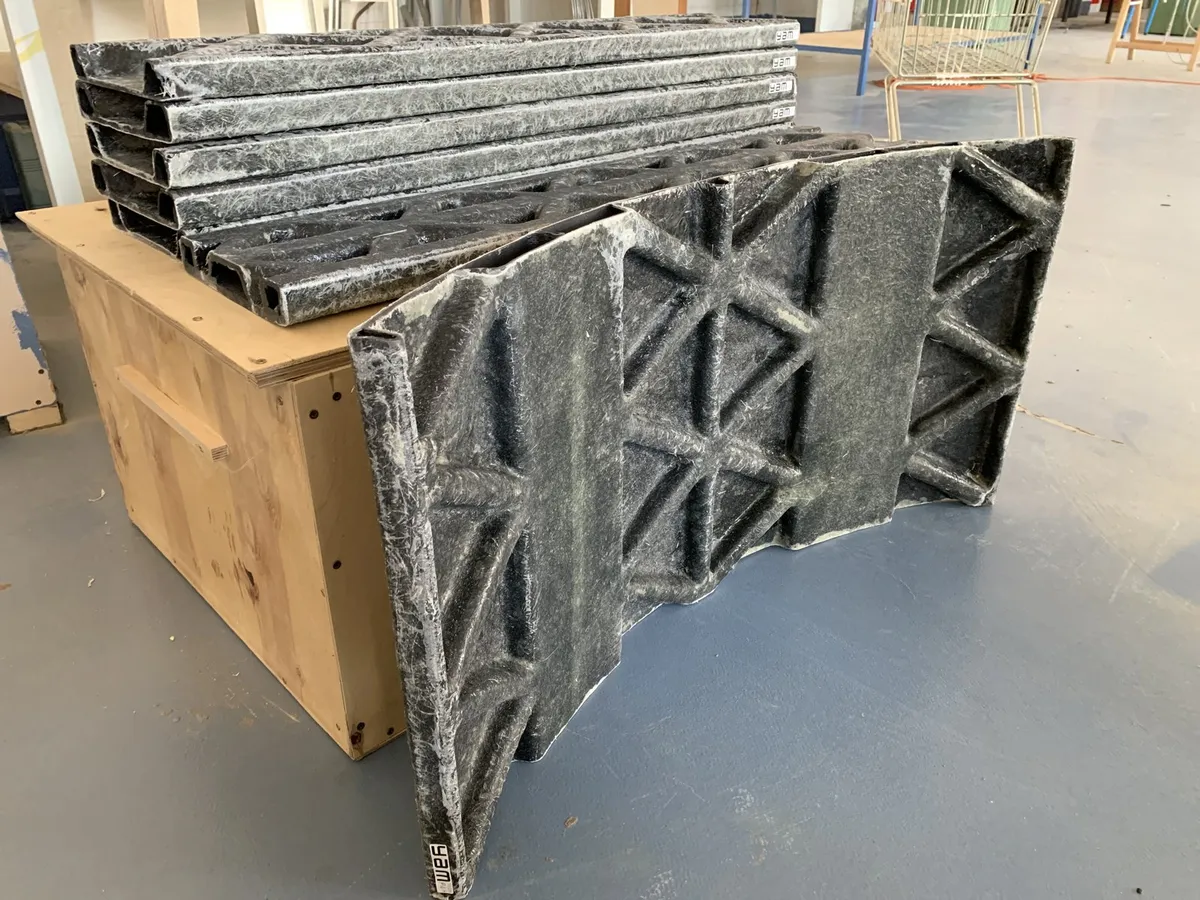
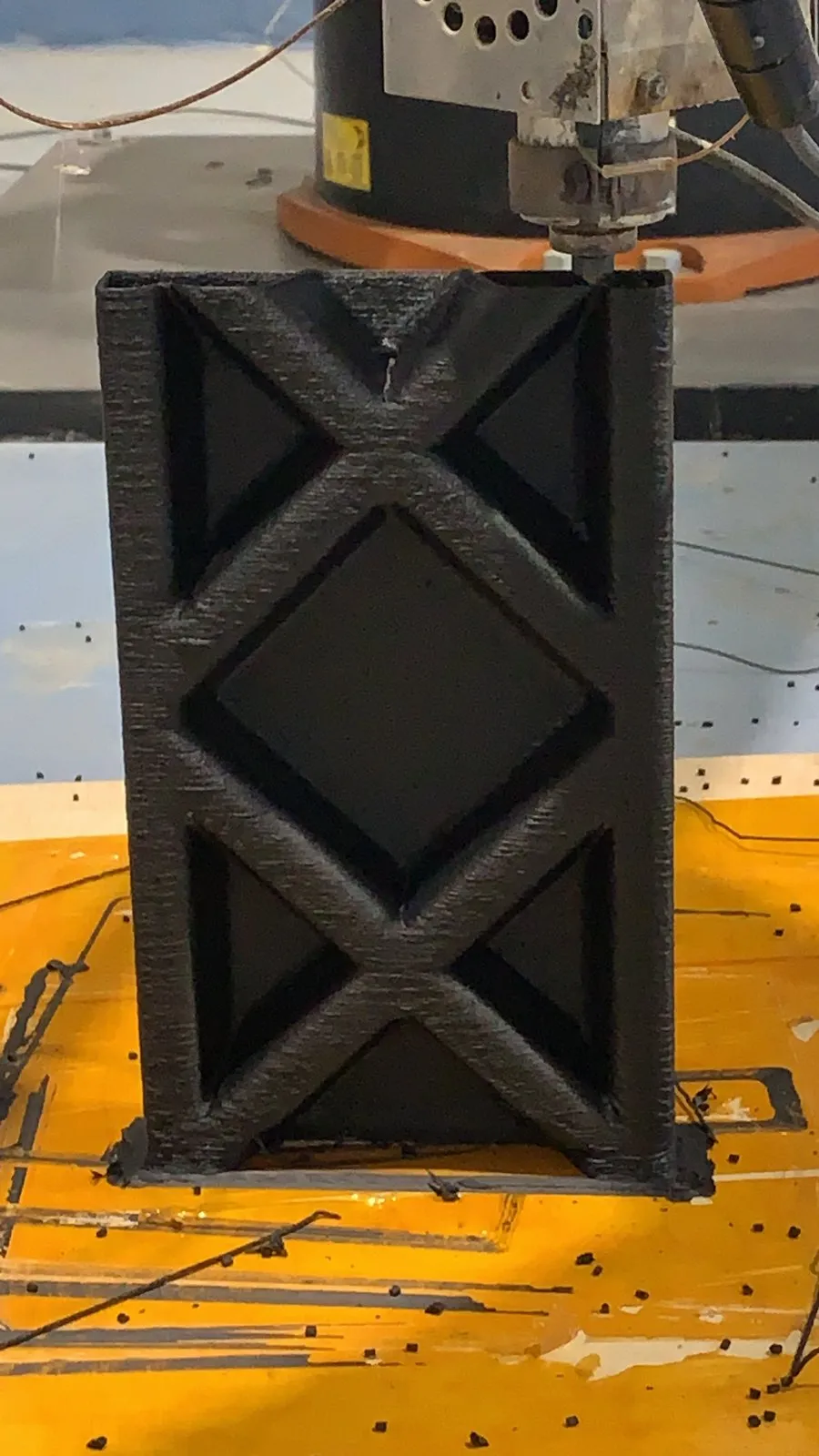
The system described is a Fanuc anthropomorphic robot carrying the NUGAE pellet extruder (15 mm screw, 1 mm nozzle), printing at 250–300 mm/s with 0.4 mm layers and walls just 1.5–2 mm thick. The part is printed as a single continuous line, with no infill. Stiffness comes from the geometry instead: the NUGAE software generates self-intersecting hollow ribs across the surface, the technique protected by our patent for load-bearing shell and plate structures. Those cavities can then be reinforced from the inside with pre-impregnated composite sleeves inflated against the print, or the part can simply be laminated on the outside. A tool changer swaps the extruder for a milling head for finishing.
After testing PLA, ASA-PC, carbon-filled ABS, PA66 and PA12, the material chosen for the marine parts was a polycarbonate reinforced with 20% carbon fibre, selected for its adhesion to the composite skins and its stability in humid conditions (it needs UV protection, like most thermoplastics at sea).
Test 1: as stiff as a balsa sandwich, about 10% lighter
The core of the study is a comparison with the panel every shipyard knows: a balsa sandwich with 2 mm vinylester-glass skins. Small specimens were tested first in three-point bending (ASTM C393), then full-size panels of 1150 × 565 mm on an 850 mm span. Finite-element models were calibrated on the tests and used to redesign the printed core.
| Balsa sandwich (reference) | NUGAE printed core + glass skins | |
|---|---|---|
| Panel size | 1150 × 565 × 47 mm | 1150 × 565 × 78 mm |
| Weight | ≈ 27.5 kg/m² | 24–26 kg/m² |
| Bending stiffness | reference | comparable |
| Ultimate strength | reference | ≈ 30% lower |
| Failure mode | sudden shear cracking of the core | progressive, in several stages, still carrying load |
The conclusion is stated plainly in the paper: the printed panels match the stiffness of the conventional panel with roughly 10% less mass, while their ultimate strength is about 30% lower. That makes them a candidate wherever weight matters more than ultimate load, and the gradual failure behaviour suggests good fatigue tolerance, which is the subject of the next studies.
Test 2: a RIB windscreen, 150 hours at sea
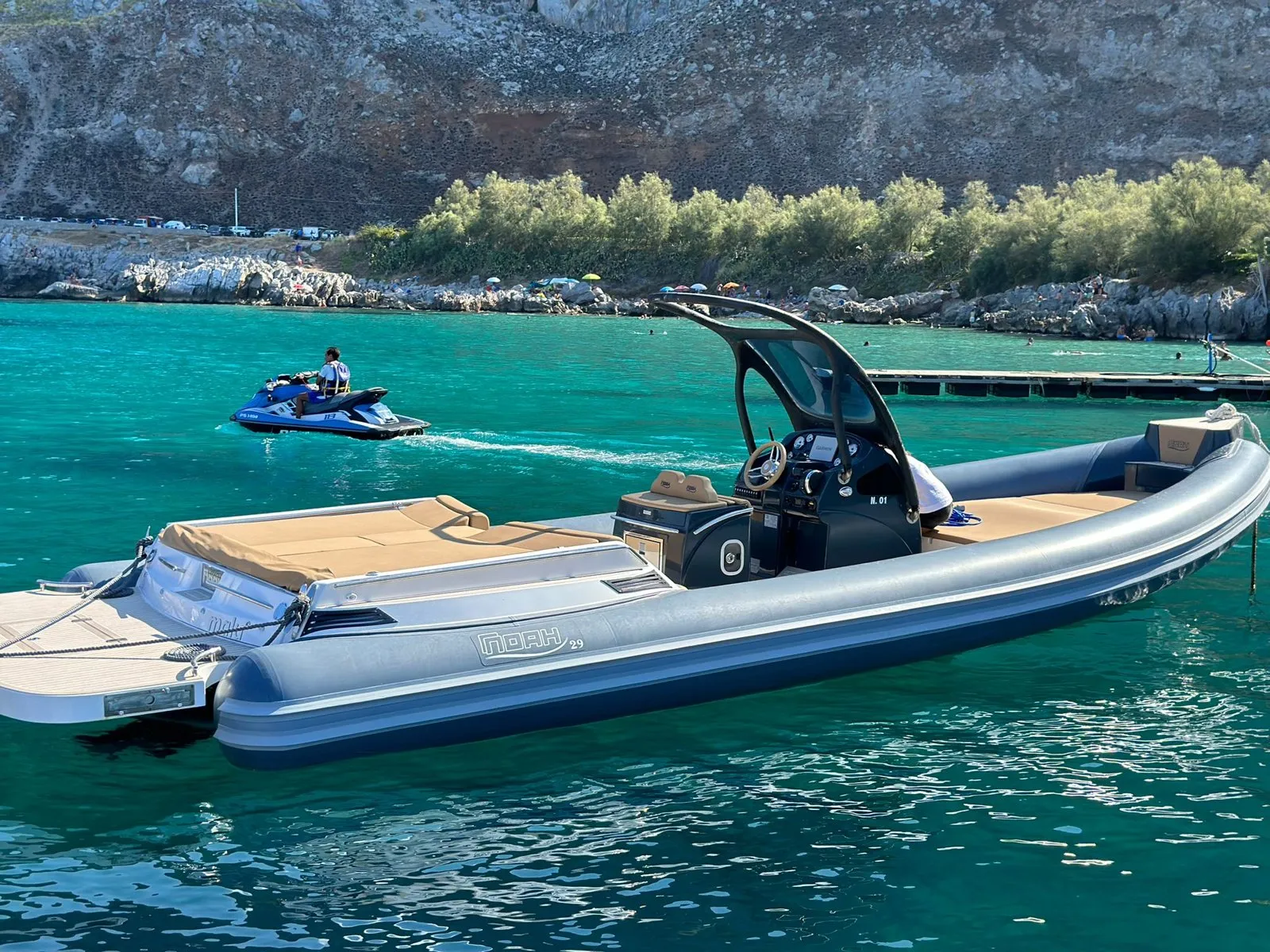
The second case study is a windscreen for a rigid inflatable boat built by a Sicilian shipyard. The organic structure was printed in three snap-fit segments, reinforced from the inside with carbon-fibre sleeves compacted at 100 kPa, painted and assembled: two days of printing and three of resin work. The whole assembly weighs 11 kg, 8 kg of which is printed. It was then used for a full summer season: 150 hours of navigation, 75 of them at 28 knots, with no structural damage.
Test 3: a hardtop for a 13-metre RIB
The third case is a full hardtop for a 13 m RIB. Printed in segments with the patented iso-grid structure, wrapped in fibreglass, sanded and faired, the finished part weighs about 60 kg and was produced twice as fast as it would have been by milling, without any mould. The boat was sold and used in varied weather with no issues reported. You can see it in our portfolio: hard top one-off.
What comes next
The authors list the open points honestly: fatigue, buckling and impact data are needed for certification, and stiffness and strength can be raised further with unidirectional fibres aligned to the loads and a better rib aspect ratio. Since the paper, that is exactly the direction NUGAE has taken: a new patented pellet extruder weighing 17 kg, the CoreLight3D® recycled core for sandwich structures shown at JEC World 2026, and a growing list of installed parts.
Read the paper
Belvisi F., Piccioni M., Ratti A. Combining Lightness and Stiffness through Composite-Reinforced Additive Manufacturing in the Yacht Industry: Case Study Analysis and Application on Large Functional Components. J. Mar. Sci. Eng. 2024, 12(6), 918. DOI 10.3390/jmse12060918. Open access under CC BY 4.0. The research was funded by the PNRR “Made in Italy Circolare e Sostenibile” (MICS) programme, Spoke 2.
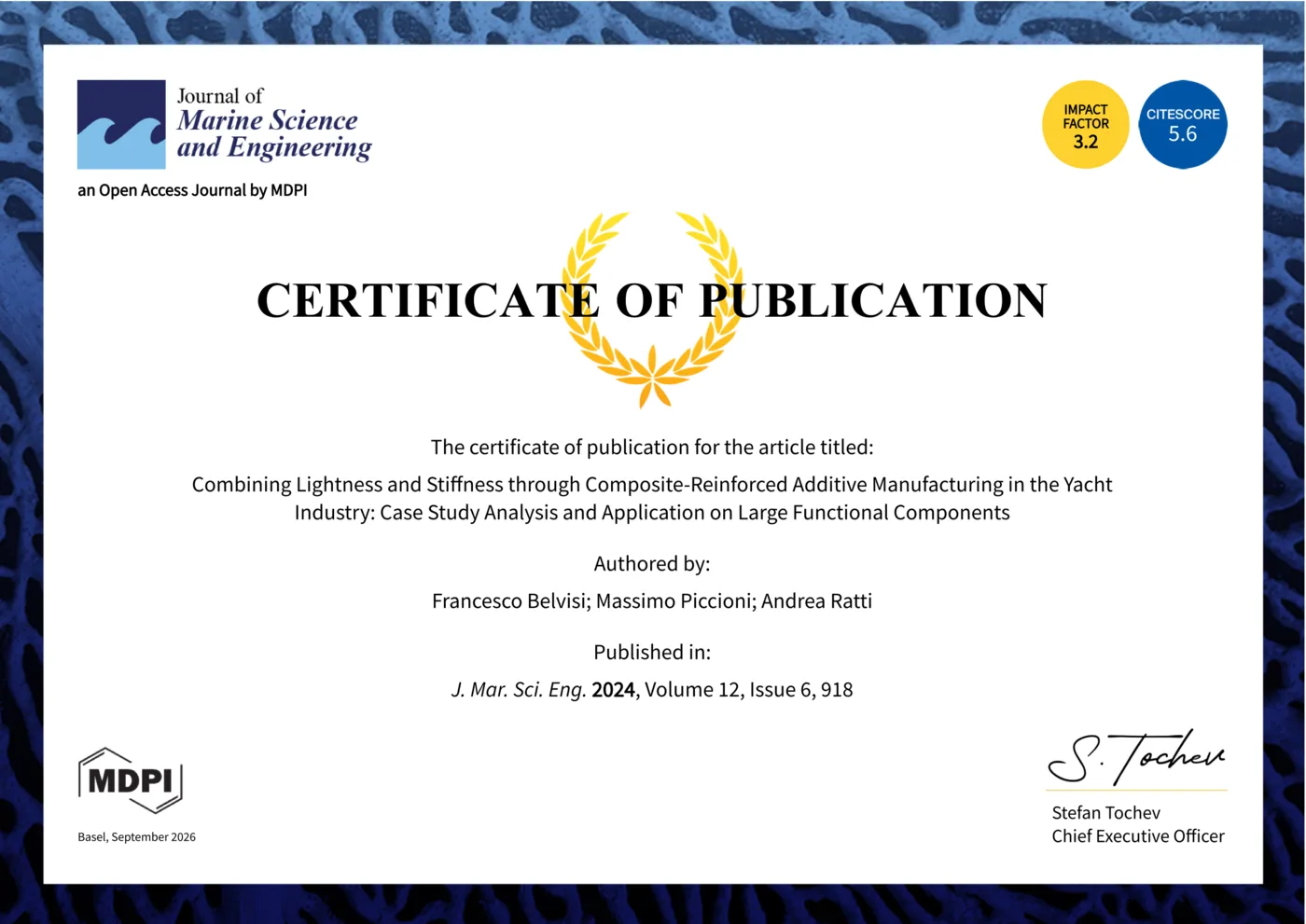
The Journal of Marine Science and Engineering is an open access journal by MDPI with an impact factor of 3.2 and a CiteScore of 5.6. In September 2026 the editorial office issued the certificate of publication for the article.
All the scientific publications on NUGAE, with links to the open access texts, are collected on the Research and publications page.
Video
Sources
Related case studies
)
)
)
Have a component to make lighter, faster or without a mould?
Challenge us