


70 kg to the North Cape and back: the 3D printed camper module completes the trip and goes around the international press
A CoreLight3D® camper cell weighing about 70 kg instead of 200 in fibreglass took a Piaggio Ape TM 703 from Italy to Nordkapp and home again: 4,500 km on the way up, nine countries, back on 6 September 2026. Covered by 3D Printing Industry, VoxelMatters and 3D ADEPT Media.
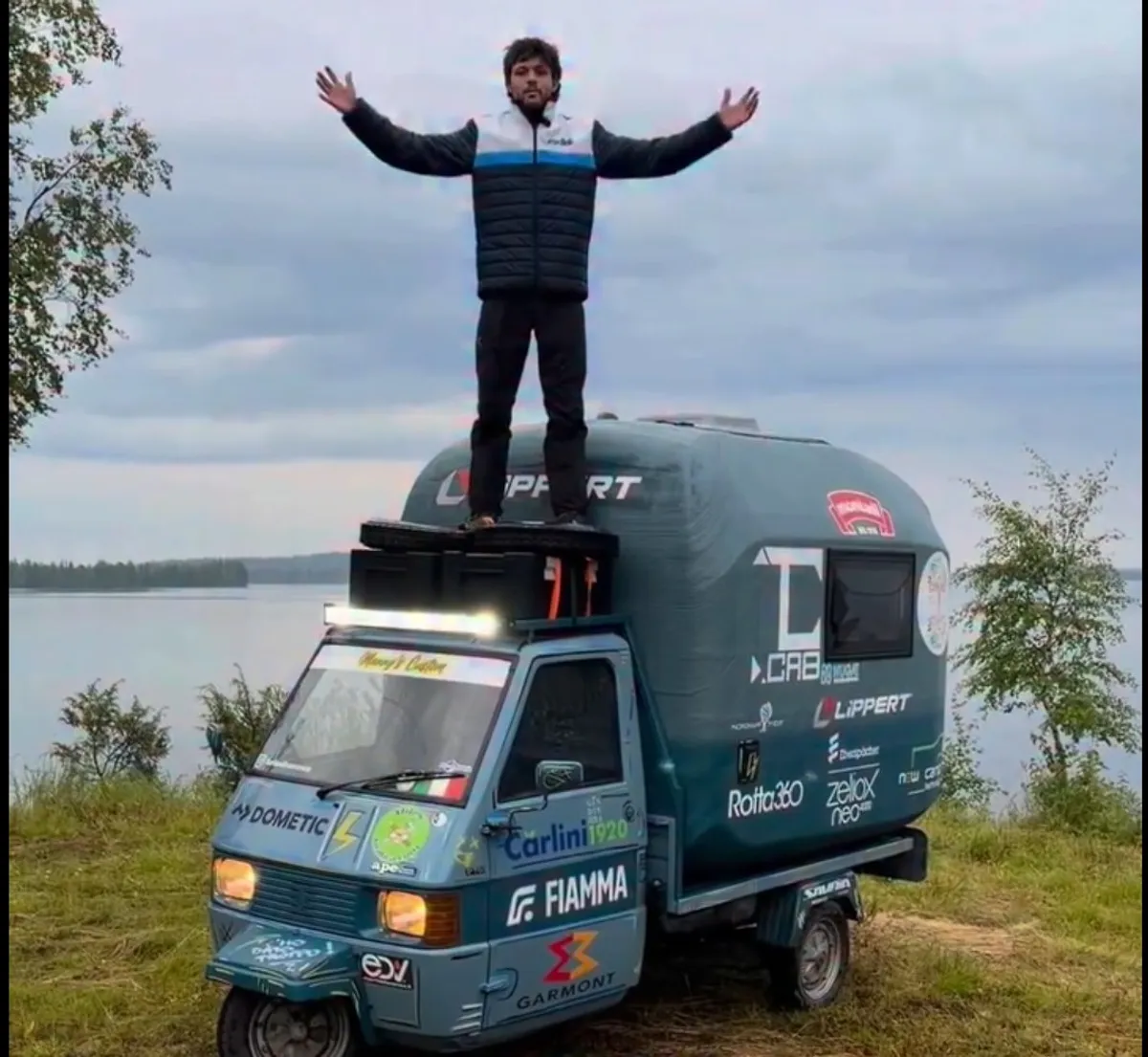
An Ape TM 703 travelling at 40-45 km/h forgives nothing. Every kilo you put on it is a kilo taken away from batteries, water, supplies and equipment, and the structure you carry has to survive thousands of kilometres of continuous vibration without cracking. That was the constraint we started from when Francesco Furlani asked us for a living module to ride from Italy to Nordkapp, the northernmost point in Europe you can reach by road.
The module we printed weighs about 70 kg. An equivalent fibreglass structure would weigh around 200. Those 130 kg saved became a bed, a kitchen, batteries, tanks and range: without them the trip simply would not have worked.
How it is made
The cell is printed in CoreLight3D®, our polypropylene material with a large share of recycled content, with 4 cm hollow, ribbed walls. It is not a solid shell lightened afterwards: the geometry is born as a sandwich, with stiffness coming from shape rather than from material thickness. Roughly 50 hours of printing for the whole module, with no mould and not a single piece of tooling to build first.
The method is what we call UL-LFAM, Ultra-Light Large Format Additive Manufacturing: a patented pellet extruder, a six-axis robot, our NU-Slice slicer and the NU-Print Large machine. Material, machine and software are developed together, and that is what allows such low apparent densities while keeping a part you can machine, bond and paint. Integration on the vehicle — mounts, openings, finishing — was handled by DCab.
The road was the test bench
Normally a component is validated in a lab. Here the test bench was the journey itself: 4,500 km across nine countries, continuous low-speed vibration, gusts up to 90 km/h on northern coastal roads, a temperature swing from over 30 °C at departure to around 2 °C at the North Cape.
And the trip did not end at Nordkapp: after reaching the northernmost point in Europe, the Ape drove all the way home. On 6 September 2026, almost two months after leaving, it was back in Verona with the module intact — same structure, same mounts, no repairs along the way. Counting the return leg, the kilometres are roughly double those quoted for the journey up.
That is exactly the kind of evidence we care about. Shipbuilders ask us the same questions — how much does it weigh, how much does it take, what happens after a thousand load cycles — when we talk about hard tops, sandwich cores or structural catamaran components. A printed roof that stays on an Ape for 4,500 km answers more convincingly than any datasheet.
Why half the world is writing about it
Between late August and the first days of September 2026 the story was picked up by 3D Printing Industry and VoxelMatters, the two leading international additive manufacturing outlets, and from there it bounced onto industry portals in Chinese (Nanjixiong, AM Yidao, Dayinmao, Dayinpai), English, Spanish, French, German and Turkish. Several newsrooms reconstructed the technology behind the part in detail, citing UL-LFAM, CoreLight3D® and the research path started by Francesco Belvisi in 2012.
The homecoming brought a second wave, different in tone. On 8 September 3D ADEPT Media ran a technical feature on the project in both its English and French editions, connecting the Ape module to the NEMO research work carried out with Politecnico di Milano. At the same time the story left the specialist press: mainstream environment and lifestyle outlets such as greenMe, wellme and NaturaPerTe told the adventure to a general audience while still devoting two full paragraphs to the material and the process. That is the part that matters most to us: large-format 3D printing stops being news for insiders and becomes the way — legible to anyone — a concrete problem got solved.
We are less interested in the article count than in why the story works: it shows in one shot what changes when the weight of a structure is divided by three. It is not a demo, it is not a trade-show piece; it is an object that did its job for weeks, continuously, on one of the least forgiving platforms imaginable.
What it means for a real project
The principle transfers. Where today there is a mould to build, a heavy part to handle and a long lead time, the same geometry can be printed directly, in one piece, with weight decided by the design rather than by the process. It applies to marine, to light mobility, to technical furniture and to fit-outs.
The full case is in the portfolio, and the questions we get most often about materials, strength and outdoor durability are answered in our FAQ. If you have a component that today is too heavy or too expensive to make, get in touch. Think big. Stay light.
Sources
- 3D Printing Industry — 70kg vs 200kg: How a Printed Foam Shell Made an Ape Camper Road-Trip Possible (August 2026)
- 3D ADEPT Media — 70 kg instead of 200: the 3D-printed living cell that drove to the North Cape (8 September 2026)
- 3D ADEPT Media (French edition) — 70 kg au lieu de 200 : la cellule habitable imprimée en 3D qui a rallié le Cap Nord (8 September 2026)
- VoxelMatters — The 3D printed camper body that took an Ape to Nordkapp (August 2026)
- greenMe — Con un'ape camperizzata dall'Italia a Capo Nord, attraverso 9 Paesi (7 September 2026, in Italian)
- 南极熊 3D打印网 (Nanjixiong) — in-depth report in Chinese (August 2026)
- AM易道 (AM Yidao) — 70公斤对抗200公斤 (August 2026)
- Wedoany English — Italian 3D-printed camper van helps Piaggio Ape cover 4,500 km to reach North Cape (August 2026)
Related case studies

Have a component to make lighter, faster or without a mould?
Challenge us